India’s E-Commerce Growth Story in 2026 Is No Longer About Discounts: It’s About Systems, Speed, and Scale
Updated on: 03/02/26 | Reading Time: 8 mins | Author : Alankrita Bajpai @Rekonsile
India’s e-commerce ecosystem in 2026 looks very different from what it did even a few years ago.
The era where growth was driven primarily by deep discounts, flash sales, and metro-centric demand is fading. What’s replacing it is far more structural, far more durable, and far more interesting.
Today, growth is being shaped by repeat consumption, smaller cities, execution quality, faster fulfilment, and technology-led decision-making. This shift marks a clear transition from event-led spikes to habit-driven commerce.
For brands, sellers, and operators, this is not just a trend; it’s a reset of how e-commerce works in India.
This article breaks down what is really driving India’s e-commerce growth in 2026, why this shift matters, and what businesses must do to stay competitive in a market that is maturing fast.
The End of Discount-Led Growth
For a long time, India’s e-commerce growth followed a predictable pattern:
Big sale events
Heavy discounts
One-time purchases
Sharp spikes followed by drop-offs
While this model helped platforms acquire users at scale, it had clear limitations:
Low customer loyalty
Thin margins
Operational stress during peak periods
Poor visibility into true profitability
In 2026, that model is no longer sufficient.
Growth is increasingly being driven by frequency, not frenzy. Customers are returning more often, buying everyday products, and integrating online shopping into their regular consumption patterns.
This change fundamentally alters how success is measured.
It’s no longer just about how many orders you process during a sale, but about:
How often do customers come back
How efficiently you fulfil orders
How well you control costs, fees, and returns
How accurately do you understand your real margins
Smaller Cities Are No Longer “Emerging”, They Are Leading
One of the most defining shifts in India’s e-commerce story is the rise of Tier-3 and smaller cities as volume leaders.
These markets are no longer:
Experimental
Price-sensitive outliers
Logistically secondary
They are now core to platform growth.
What’s happening in smaller cities?
Order volumes are growing faster than in metros
Demand is increasingly focused on daily-use and health-oriented products
Categories like FMCG, food, wellness, and personal care are seeing strong traction
Customers are buying repeatedly, not just occasionally
This indicates something important: trust has been established.
Smaller-city consumers are no longer “trying out” e-commerce. They rely on it.
Why This Changes Everything for Sellers
Serving smaller cities at scale requires a very different operational mindset.
Margins are often tighter.
Volumes are higher.
Return behaviour can vary widely.
Fee structures differ across marketplaces.
GST reconciliation becomes more complex.
When a large share of your orders comes from multiple geographies and platforms, manual financial tracking breaks down quickly.
This is where many sellers feel profitable on paper, but quietly lose money through:
Incorrect marketplace fees
Untracked deductions
Missed claims
Tax mismatches
Pricing inconsistencies across platforms
In a structurally growing market, leakages matter more than ever.
The brands that win are not just the ones selling more, but the ones that can clearly see:
What they actually earn per SKU
Where money is getting stuck or lost
Which products scale profitably
Which marketplaces are silently eroding margins
This is why modern e-commerce growth is increasingly dependent on financial clarity, not just marketing spend.
Repeat Consumption Is the New Growth Engine
Another defining characteristic of 2026 is the shift from one-time purchases to repeat buying.
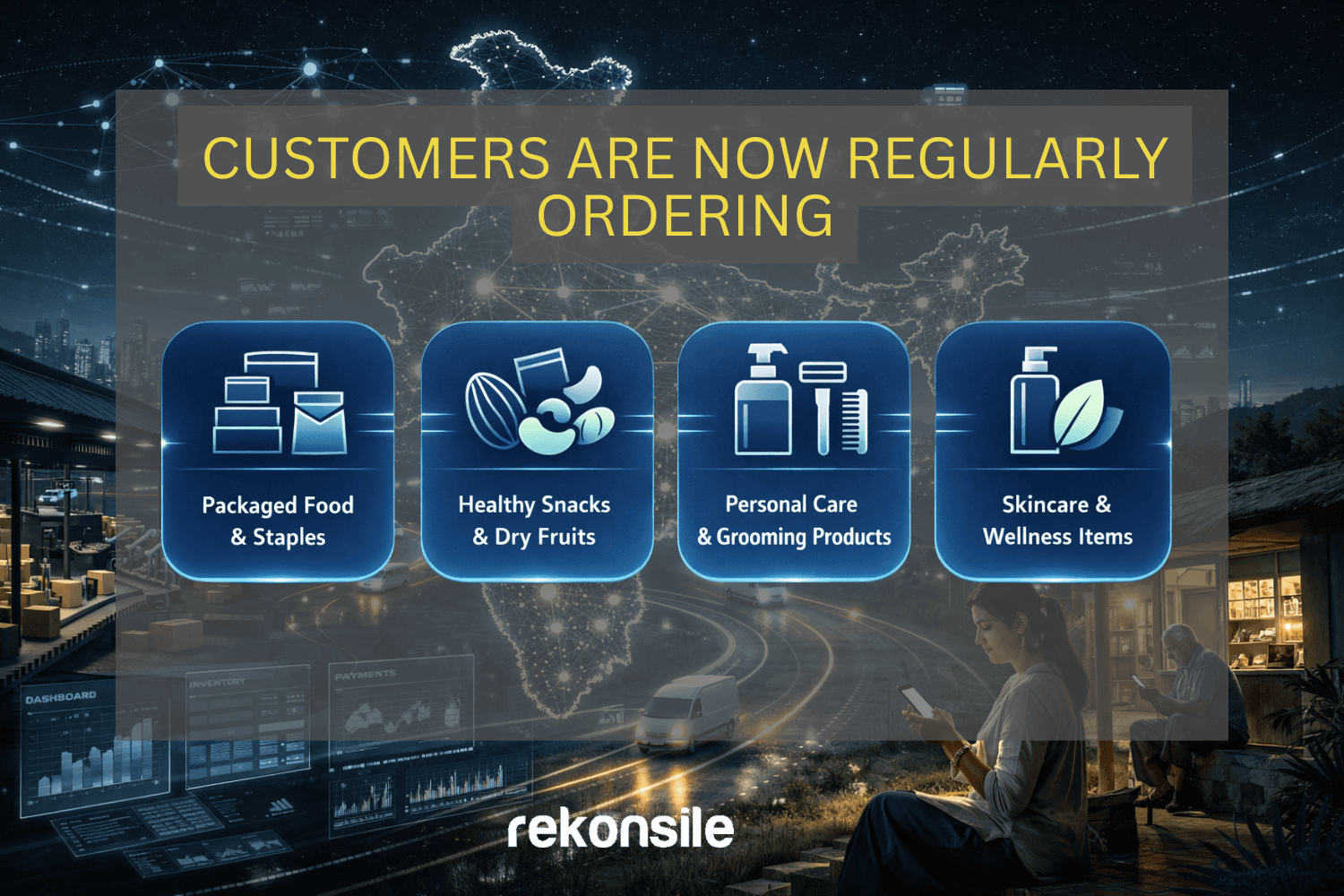
Instead of only shopping during major events, customers are now regularly ordering:
Packaged food and staples
Healthy snacks and dry fruits
Personal care and grooming products
Skincare and wellness items
These are habit-driven categories, not impulse buys.
What repeat consumption really means
Repeat consumption changes the economics of e-commerce:
Customer acquisition cost (CAC) matters less over time
Retention and frequency matter more
Unit economics must be tightly controlled
Inventory planning becomes critical
Returns and refunds need deeper analysis
In this environment, sellers need to understand not just what sells, but what sells repeatedly and profitably.
That requires SKU-level visibility into:
Contribution margins
Returns impact
Marketplace fees
Storage and fulfilment costs
Without this visibility, growth can look healthy on the surface, while profitability quietly declines underneath.
Execution Quality Has Become a Competitive Advantage
In earlier phases of e-commerce, pricing and promotions often masked operational inefficiencies.
In 2026, they don’t.
Customers now expect:
Faster delivery
Accurate order fulfilment
Transparent communication
Fewer cancellations and delays
Channels that prioritise speed and reliability are seeing disproportionate growth, highlighting a shift in customer expectations.
But faster execution also means:
More complex inventory routing
Higher operational costs if mismanaged
Greater exposure to fee discrepancies and penalties
As order volumes grow, manual reconciliation becomes a bottleneck.
Many sellers still rely on:
Spreadsheet-based tracking
Delayed settlement reports
Fragmented data from multiple marketplaces
At scale, this approach is unsustainable.
Modern sellers are moving towards automated reconciliation systems that:
Pull data directly from marketplaces
Match orders, payments, fees, and returns automatically
Flag discrepancies in real time
Provide audit-ready financial views
This shift is less about convenience and more about survival in a high-volume, low-margin environment.
Why Financial Infrastructure Is Now as Important as Logistics
In a structurally growing e-commerce market, revenue is no longer lost in obvious ways.
It leaks quietly:
Through incorrect referral fees
Through weight handling or pick-and-pack errors
Through unclaimed refunds
Through damaged or lost inventory
Through GST mismatches
Individually, these issues may seem small.
At scale, they compound.
This is why forward-looking sellers are investing in platforms that:
Centralise marketplace data
Offer SKU-level profitability insights
Monitor fees across platforms
Track negative profit and suspense balances
Simplify GST reconciliation
The goal is not just to sell more, but to retain what you earn.
Some of the most efficient sellers today treat financial reconciliation as a core operational layer, not a back-office task.
The Quiet Role of Automation and AI
Another major shift shaping e-commerce growth in 2026 is the increasing use of automation and AI, not just for marketing, but for operations.
Automation now powers:
Real-time inventory sync
Order routing
Financial reconciliation
Discrepancy detection
Performance analytics
AI adds another layer by:
Highlighting unusual patterns
Identifying high-impact revenue leaks
Generating actionable insights from complex datasets
Instead of manually hunting for problems, sellers are increasingly guided by data-driven alerts and recommendations.
This doesn’t just save time; it improves decision quality.
What This Means Going Forward
India’s e-commerce growth story in 2026 is not slowing down.
It is deepening.
Growth is:
More distributed geographically
More frequent consumption
More dependent on execution
More sensitive to margins and fees
More reliant on automation and financial intelligence
The winners in this phase will not be the loudest brands, but the most operationally disciplined ones.
Those who invest early in:
Clean data
Automated reconciliation
Fee and margin visibility
Tax compliance
SKU-level insights
will find it easier to scale without chaos.
AI-Led Engagement Is No Longer Optional, It’s Closing the Conversion Gap
As India’s e-commerce ecosystem matures, another shift has become impossible to ignore: conversion is no longer just a marketing problem.
In 2026, brands are seeing a clear gap between:
Customers who intend to buy
Customers who actually complete the transaction
This gap shows up everywhere:
Abandoned carts
Failed last-minute deliveries
Missed payment retries
Unresolved COD confirmations
Unclaimed refunds
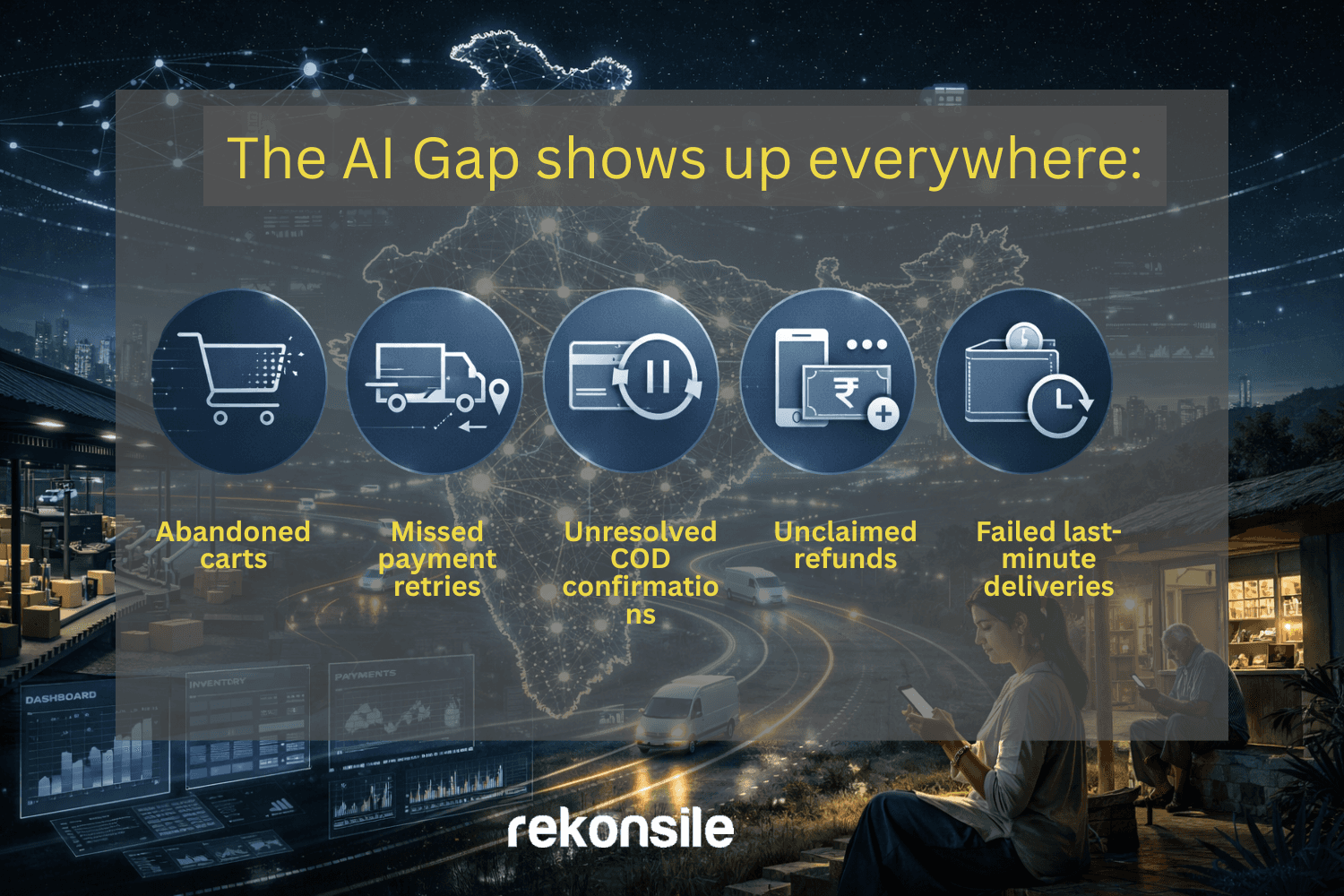
What’s changed is how brands are responding.
Instead of throwing more discounts or ads at the problem, sellers are increasingly turning to AI-led engagement and automation to convert high-intent demand.
Where AI is actually making money
AI is no longer being used as a “nice-to-have” chatbot or experiment. Its most impactful use cases are deeply operational:
Automated customer nudges across WhatsApp, SMS, and RCS
Payment reminders and order confirmations
Last-mile communication for delivery success
Recovery of high-intent but incomplete orders
The key insight here is simple:
Most lost revenue in mature e-commerce isn’t demand-related; it’s execution-related.
And AI excels at execution.
Faster Fulfilment Has Raised the Cost of Errors
Speed has become a baseline expectation.
Customers now assume:
Same-day or next-day delivery
Accurate order tracking
Instant updates
Minimal friction
While faster ffulfilmentincreases conversions, it also magnifies operational errors.
At high velocity:
Pricing mistakes go unnoticed longer
Fee overcharges compound faster
Inventory mismatches become expensive
Return-related losses spike
When order volumes scale quickly, even small discrepancies can turn into serious financial drag.
This is where many sellers struggle.
They grow fast, but lack the systems to:
Monitor fees in real time
Validate pricing across marketplaces
Track warehouse damages and storage costs
Identify SKUs slipping into negative profit
Without a strong financial backbone, speed can hurt as much as it helps.
Why Brand-Owned Channels Are Quietly Winning
Another notable trend in 2026 is the steady rise of brand-owned websites as a growth channel.
This doesn’t mean marketplaces are losing relevance; they still process the largest share of orders. But brands are increasingly prioritising their own channels for strategic reasons:
Better control over customer data
Higher margins
Direct communication
Stronger brand loyalty
However, running a brand-owned channel alongside multiple marketplaces introduces complexity.
Data becomes fragmented.
Reconciliation becomes harder.
Tax compliance becomes trickier.
Accounting gets messy fast.
This is why sellers managing multiple channels are rethinking how they handle finance and reporting.
Instead of treating each platform separately, they’re moving towards centralised reconciliation and reporting systems that unify:
Marketplace settlements
Website orders
Fees, refunds, and claims
GST liabilities
This unified view is what enables confident scaling.
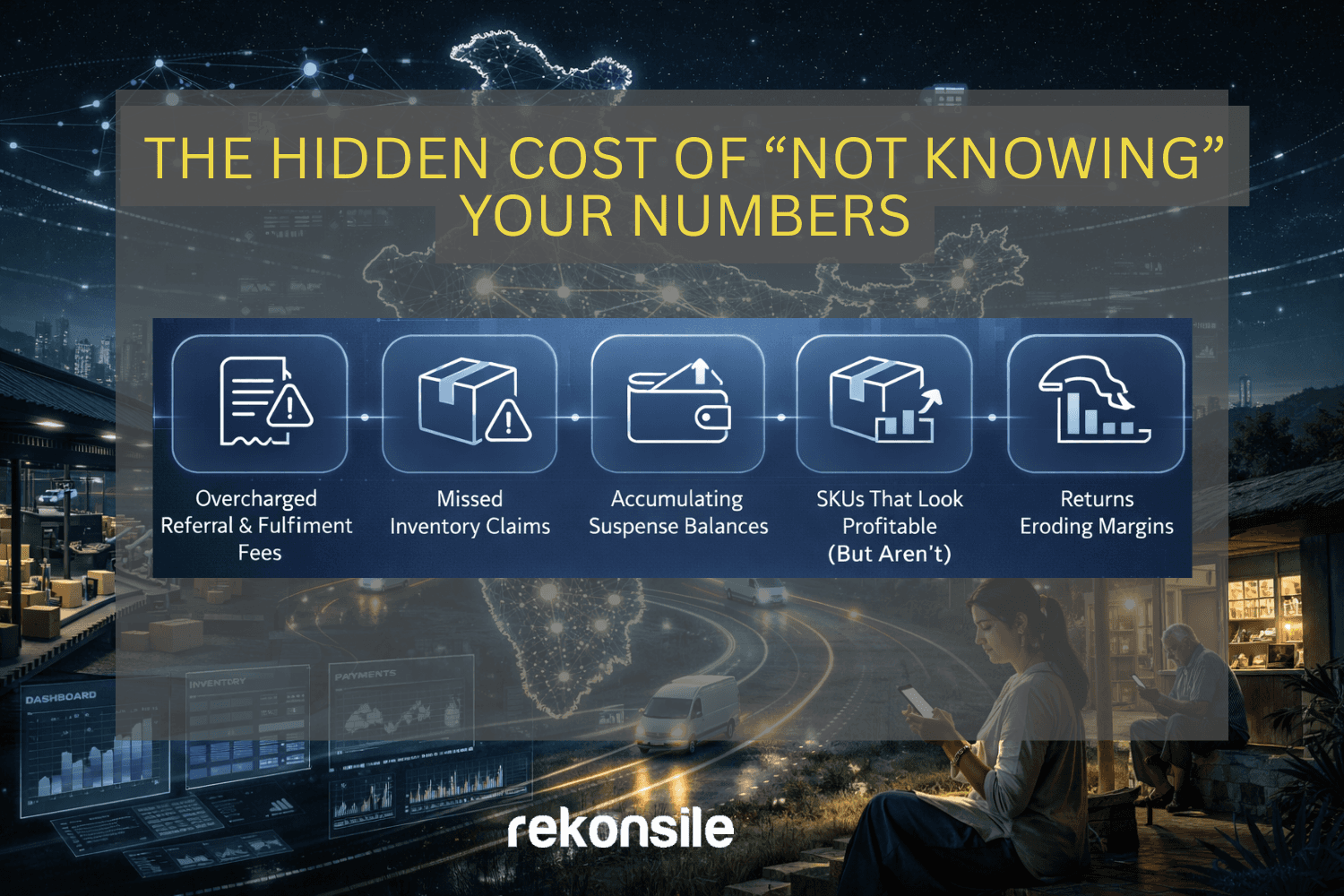
The Hidden Cost of “Not Knowing” Your Numbers
One of the most dangerous myths in e-commerce is:
“As long as sales are growing, things are fine.”
In reality, many sellers only discover problems when:
Cash flow tightens
Profit margins shrink unexpectedly
GST notices arrive
Marketplace audits flag discrepancies
By the time issues surface, months of data may already be compromised.
Common blind spots include:
Unnoticed overcharges in referral or fulfilment fees
Missed claims for lost or damaged inventory
Suspense balances that quietly accumulate
SKUs that look profitable but aren’t
Returns that erode margins more than expected
These are not edge cases; they’re systemic.
In a structurally growing market, visibility becomes as important as velocity.
Why SKU-Level Intelligence Is Non-Negotiable in 2026
As repeat consumption increases, not all products contribute equally to growth.
Some SKUs:
Drive high volume but low margins
Attract frequent returns
Carry hidden storage or handling costs
Others:
Scale profitably
Have low return rates
Perform consistently across marketplaces
Without SKU-level insights, sellers often:
Over-invest in the wrong products
Underestimate return-related losses
Misjudge true contribution margins
This is why modern sellers rely on systems that break down performance by:
SKU
Order
Marketplace
Time period
And crucially, separate COGS from tax, so margin analysis reflects reality.
When this data is automated and centralised, decision-making becomes sharper:
Pricing becomes more accurate
Inventory planning improves
Loss-making SKUs are identified early
GST Compliance Is Becoming a Growth Enabler, Not a Burden
As volumes increase and sellers expand across regions, GST compliance becomes more complex.
Manual reconciliation between:
Marketplace reports
Bank settlements
GST filings
is not just time-consuming; it’s risky.
Errors can lead to:
Incorrect tax payments
Compliance notices
Audit challenges
Cash flow disruptions
In 2026, many sellers are reframing GST compliance not as a regulatory headache, but as an operational necessity.
Automated GST reconciliation ensures:
Accurate liability calculation
Consistency across platforms
Audit-ready reporting
This reduces risk and allows finance teams to focus on strategy instead of firefighting.
Why the Best Sellers Are Building Invisible Infrastructure
The most successful e-commerce businesses in 2026 don’t necessarily look flashy from the outside.
What sets them apart is what runs underneath:
Automated reconciliation
Real-time fee monitoring
Centralized dashboards
AI-generated insights
Clean accounting integrations
They don’t wait for problems to surface; they detect them early.
Platforms that quietly handle:
Marketplace data syncing
Discrepancy detection
Claim tracking
Financial reporting
have become foundational tools, not optional add-ons.
In many cases, sellers using such systems don’t talk about them publicly, but they scale faster, cleaner, and with fewer surprises.
The Bigger Picture: Structural Growth Needs Structural Systems
India’s e-commerce growth in 2026 is not fragile.
It’s broad-based.
It’s habit-driven.
It’s geographically diverse.
It’s operationally demanding.
This kind of growth doesn’t reward shortcuts.
It rewards:
Discipline over discounting
Systems over spreadsheets
Insight over instinct
Automation over manual effort
As repeat consumption deepens and smaller cities drive volumes, the businesses that thrive will be the ones who treat finance, reconciliation, and compliance as growth infrastructure, not afterthoughts.
The Bottomline
India’s e-commerce story is no longer about who can shout the loudest during a sale.
It’s about:
Who understands their numbers
Who executes reliably at scale
Who retains profitability while growing
Who builds systems that don’t break under pressure
In 2026, growth is not accidental.
It’s engineered. And the sellers whorecognisee this early and build accordingly will define the next chapter of Indian e-commerce.
