How to sell on Myntra? Complete Guide with Step-by-Step
Updated on: 26/11/25 | Reading Time: 10 mins | Author : Alankrita Bajpai @Rekonsile
Selling on a major fashion marketplace can transform a small clothing or accessories brand into a national Bestseller. If you want to sell on Myntra, this guide explains the entire process. You’ll learn what Myntra is, what Myntra Seller Central is, what documents are needed, the exact steps to get started, and the key terms you must understand before making your first listing.
1) What is Myntra and why choose it?
Myntra is one of India’s largest online fashion and lifestyle marketplaces. It focuses on clothes, footwear, accessories, beauty, and related categories. If your brand or shop sells fashion items, Myntra reaches buyers who are specifically looking for style, sizes, seasons, and trends. Compared to general marketplaces, Myntra offers a more focused audience ready to buy fashion. That is the main reason many boutique owners or small brands choose Myntra first.
When you join Myntra, you use a special dashboard to manage your products, prices, inventory, orders, and payments, called Myntra Seller Central. This is where many new sellers struggle, especially when payouts, deductions, returns, and GST entries start piling up. That’s why many fashion brands pair Myntra Seller Central with tools like Rekonsile to keep track of settlement mismatches, return leakages, and fees across Amazon, Flipkart, and Myntra. It ensures sellers don’t lose money silently due to hidden charges or reconciliation gaps.
2) What Myntra Seller Central does for you
Myntra Seller Central is the seller portal. Inside it, you can:
Register your business
Upload product images and descriptions
Set sizes, colours, and stock quantities
View orders, track shipments, and accept returns
Check your earnings and payouts
Watch performance metrics like delays or cancellations
Because fashion comes in many sizes, colours, and styles, Myntra Seller Central helps you keep everything organised in one place. You don’t have to hunt for separate emails or spreadsheets; the portal stores all relevant information and guides you through required actions.
3) Documents you need before registering on Myntra
Every business must prepare certain documents. For Myntra, common requirements include:
GST registration certificate
PAN of the business or owner
Bank account details
Address proof for your warehouse or pickup location
Brand ownership proof or authorisation letter if selling under a brand
Contact details like phone and email
Collecting these before you start speeds up the onboarding on Myntra Seller Central. If any document is missing, the registration may stall or take longer.
4) Step‑by‑step onboarding to Myntra via Myntra Seller Central
Step 1: Start registration
Go to Myntra’s partner or seller portal. You should see a Register or Sign‑Up option. The portal will ask for basic business information, and you must upload scanned copies of the required documents.
Step 2: Verification
After submission, Myntra reviews your documents and business details. Depending on the onboard model, timelines may vary. Once your account activates, this is where sellers often start seeing early payout confusion, especially during returns, RTO, or sample shipments. Using Rekonsile alongside Myntra Seller Central helps new sellers track each payout, return charge, commission, and settlement clearly, so nothing goes unnoticed.
Step 3: Complete portal setup
Once approved for Myntra Seller Central, you set up your product catalogue. This includes preparing size charts, uploading multiple photos, writing clear descriptions, and setting prices. The portal guides you to enter each SKU and stock level.
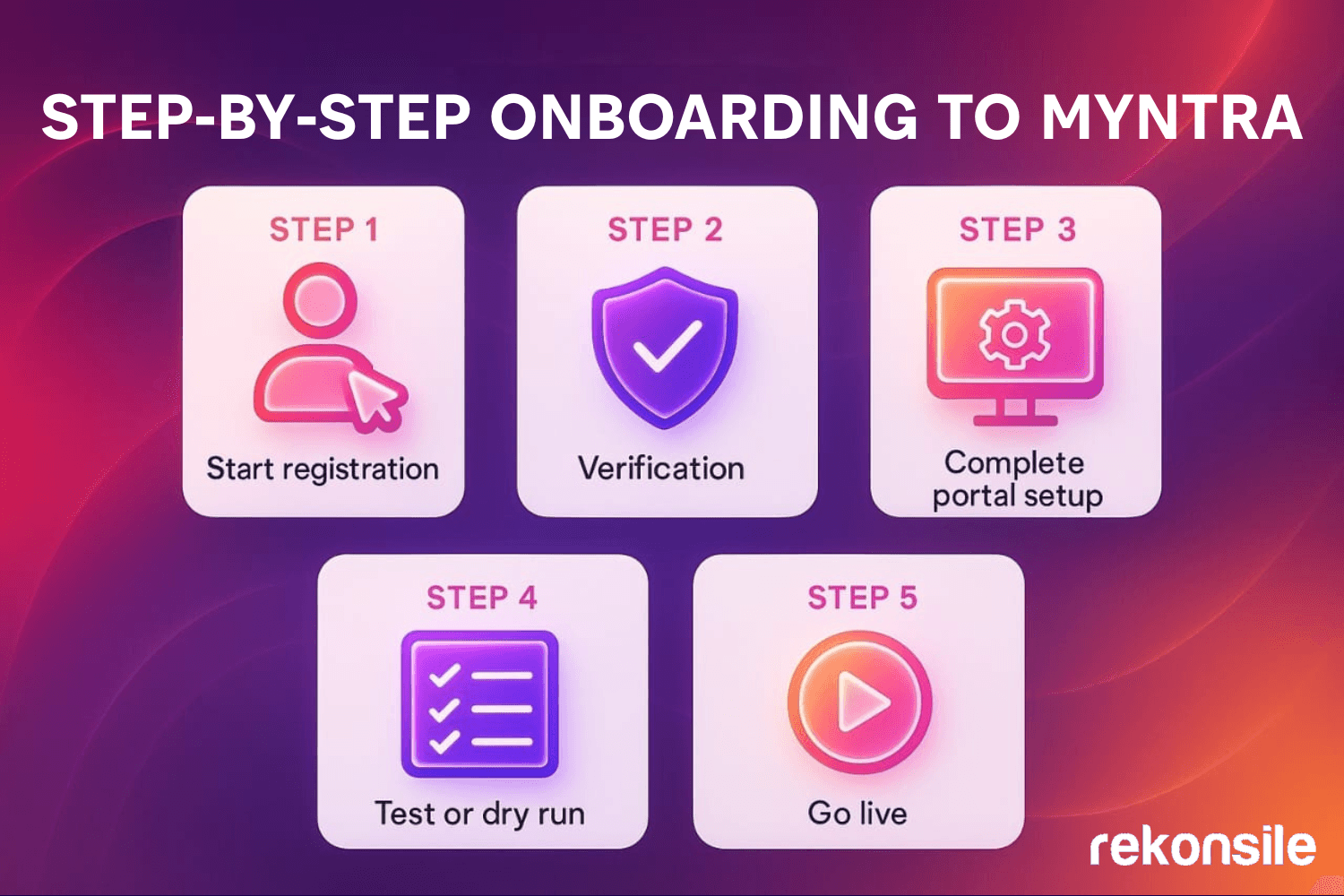
Step 4: Test or dry run
Before live sales, Myntra may test the order fulfilment process or require sample shipments to ensure quality. This step helps avoid issues later with returns or poor customer experiences. Sellers should treat this like a rehearsal for real orders.
Step 5: Go live
After all checks and catalogue upload, your products go live on Myntra. Orders start coming in, and you manage them through Myntra Seller Central. You will pack, label, and hand over items as per Myntra’s instructions.
5) Important terms you must understand on Myntra before listing
When you use Myntra Seller Central, you will see many words used frequently. Here are the most important ones explained simply.
SKU in Myntra
Stock Keeping Unit. A unique code or ID for each specific product variant. For example, a red kurta in size M is one SKU; the same kurta in size L is another SKU. You must create a separate SKU for each size or colour.
Listing in Myntra
A product page visible to customers. It contains images, title, price, size options, and description. Each SKU links to one listing or multiple related product variants.
Catalog in Myntra
All the listings you upload to Myntra. You manage your catalogue in Myntra Seller Central. A clean catalogue makes it easier to update prices and stock.
Order fulfilment in Myntra
The process of packaging and sending the product after a customer buys it. Myntra gives you guidelines for packing, labels, and pickup. You must complete this on time for good performance.
Return or refund in Myntra.
When a customer sends back a product. Fashion returns happen more often than electronics or household items. Myntra will process return logistics, but you must handle re‑stocking or accept deductions for returned items.
Commission or fees in Myntra
A percentage of your selling price that Myntra keeps for providing the marketplace, customer base, and logistics infrastructure. This reduces your net payout. Commission rates can vary by category or model.
Payout or settlement in Myntra
The money is transferred to your bank account after sales, after deductions for commission, fees, taxes, or returns. You check payouts inside Myntra Seller Central. A lot of beginners don’t fully understand how these deductions work, so pairing your Myntra payouts with Rekonsile helps ensure every rupee is accounted for, especially when tracking return-related charges or mismatches.
6) Why does catalogue quality matter so much on Myntra
Fashion shoppers judge products from photos and descriptions. A poor photo or wrong colour wording leads to lower sales or more returns. High catalogue quality includes:
Clear front, back, and close‑up photos
Neutral background or consistent styling
Accurate colour naming and fabric details
Correct size chart matching your measurements
Additional images showing texture or accessories
On Myntra, the quality of your catalogue directly affects whether your listing gets approved, how it ranks in searches, and the likelihood of sales. Poor catalogue quality can lead to listings being removed or reduced visibility, which reduces revenue from your stock investment.
7) How to price products on Myntra
Pricing is one of the hardest steps for new sellers. You cannot just add a fixed margin to your cost. You must include:
Myntra commission
Packaging or logistics charges
Return costs
Taxes and GST
Sale season discounts
Any promotional fees or advertising
Even if you plan a 30 percent profit, after deductions, your actual profit may drop significantly. Most sellers notice this only after their first settlement cycle. Using Myntra Seller Central reports along with a reconciliation tool like Rekonsile helps you cross-check commissions, RTO fees, GST, and promotional charges so you can price your listings with full clarity and avoid losing margin.
8) Logistics and responsibilities on Myntra
What you do
Pack items neatly using Myntra guidelines
Use correct labels or stickers from Myntra Seller Central
Ensure stock is updated and accurate for each SKU
Dispatch orders on time or hand them over to pickup agents
What Myntra does
Pick up packages using its courier network
Deliver to customers
Handle tracking updates and customer service for shipping
Process returns and refunds as per policy
This division helps small sellers who may not want to manage multiple courier partners or complicated return flows. Still, you must follow all Myntra rules strictly. Violations can lower your seller rating or cause penalties.
9) Performance measures to watch in Myntra Seller Central
Myntra monitors seller performance, usually through several metrics:
Late dispatch rate: how often you send packages late
Cancellation rate: how often you cancel orders from your end
Order defect rate: returns due to quality or other issues
Customer ratings or feedback
If these metrics go beyond allowed thresholds, Myntra may limit your visibility, restrict listings, or even pause your account. So treat these numbers as critical as your costs or catalogue quality. Address any warning or alert in Myntra Seller Central immediately.
10) Planning your first month on Myntra
When you begin, take these practical steps:
Upload only a few SKUs first, maybe your best sellers or easiest products to manage.
Check how quickly you can pack and dispatch products. If there is a delay, solve it before adding more SKUs.
Monitor returns closely. If you have more returns than expected for a particular SKU, review the listing photo, description, or size chart.
Look at your payout in Myntra Seller Central weekly, not just monthly. Understand what deductions happened and why.
Tools like Rekonsile make this easier by showing you settlement mismatches, overcharges, or return-based revenue leakages so you stay profitable from the beginning.
Start collecting customer feedback; even one positive rating can improve your visibility.
11) What to expect next
After you complete these first steps on Myntra Seller Central, your focus shifts to improving listings, maintaining stock, ensuring timely dispatch, reducing returns, and gradually adding more products. Part 2 will give the precise checkout, listing, order, and payout steps in even more detail, and will provide a tight numerical example showing your real earnings after all Myntra charges and fees.
12) How product listing works on Myntra step by step
Once your initial catalogue is ready, the next stage on Myntra is understanding how each listing moves through approvals. The process begins inside Myntra Seller Central, where you upload images, titles, fabrics, wash instructions, style details, and size options.
Every listing on Myntra passes through multiple quality checks. These include image clarity, size chart accuracy, correct category mapping, and compliant product attributes. If any detail is incorrect, Myntra Seller Central will mark the SKU as “Needs Fixing,” which means you must edit the rejected fields.
To avoid frequent rejections on Myntra, follow the exact attribute standards. For example, if you are listing a women’s kurta, the portal may require length type, fabric type, sleeve pattern, and occasion tags. Missing even one mandatory field causes delays. Myntra Seller Central also lets you clone SKUs, meaning if you have the same kurta in 5 colours, you don’t need to recreate the listing from scratch. This speeds up catalogue expansion.
Rekonsile Pro tip: Always review the “Browse Node” or category tree on Myntra. If you select the wrong category, your product may appear to the wrong audience, affecting impressions and sales. Good category mapping makes a major difference because buyers on Myntra often search by specific filters.
13) How shipping and order flow work on Myntra
When a customer places an order on Myntra, it instantly appears inside Myntra Seller Central under the “Pending Dispatch” tab. You then print the shipping label, pack the product as per guidelines, and mark it “Ready for Pickup.” A logistics partner of Myntra will collect it from your pickup address. For most cities, the pickup happens the next business day.
Myntra Seller Central tracks every stage of the delivery. You will see statuses like Order Placed, Packed, Picked Up, In Transit, Out for Delivery, and Delivered. If a customer cancels before delivery, the order returns to your warehouse automatically. This is called RTO (Return to Origin), and it has associated charges. Managing RTO is extremely important on Myntra because fashion categories have a higher return behaviour.
If you notice frequent RTOs, check your product sizes or descriptions. Myntra Seller Central provides SKU-level reports showing the exact return rate, which helps you see if sizing, photos, or fit details need improvement. Even reducing RTO by 5 percent can increase your net profit significantly.
14) How payouts and settlements work on Myntra
Every sale on Myntra is paid out to your bank account after subtracting commissions, GST, logistics charges, and return fees. All of this is detailed in Myntra Seller Central under the Payouts and Settlement tabs. Understanding this section is essential to calculating actual profit.
Here is an example for clarity:
Suppose you list a top on Myntra for ₹250.
A typical deduction structure may look like this:
Commission fee (20% of ₹250) = ₹50
GST on commission (18% of ₹50) = ₹9
Logistics fee (weight-based) = ₹35
Collection/payment fee = ₹10
Return handling fee (if returned) = ₹20
If the product is delivered successfully and not returned, your net payout is:
₹250 – ₹50 – ₹9 – ₹35 – ₹10 = ₹146
But if the customer returns the item, your net payout becomes:
₹250 – ₹50 – ₹9 – ₹35 – ₹10 – ₹20 = ₹126
This is why sellers must understand each deduction. Myntra Seller Central shows a breakup for all charges, but reconciling everything manually becomes difficult when you have 40–50 SKUs. Many fashion sellers use Rekonsile to cross-verify if Myntra deducted the exact fees correctly, especially during high-return periods or mega-sales when mismatches are common.
15) How much can I earn on Myntra?
Your earnings on Myntra depend on category, pricing strategy, return rate, and logistics cost. In fashion, the margins are tight but scalable. For example, a kurti priced at ₹799 may give a net payout of ₹450–₹520 after deductions. Higher MRP items usually have better absolute margins. Myntra Seller Central provides detailed SKU profit calculations, but interpreting them requires effort.
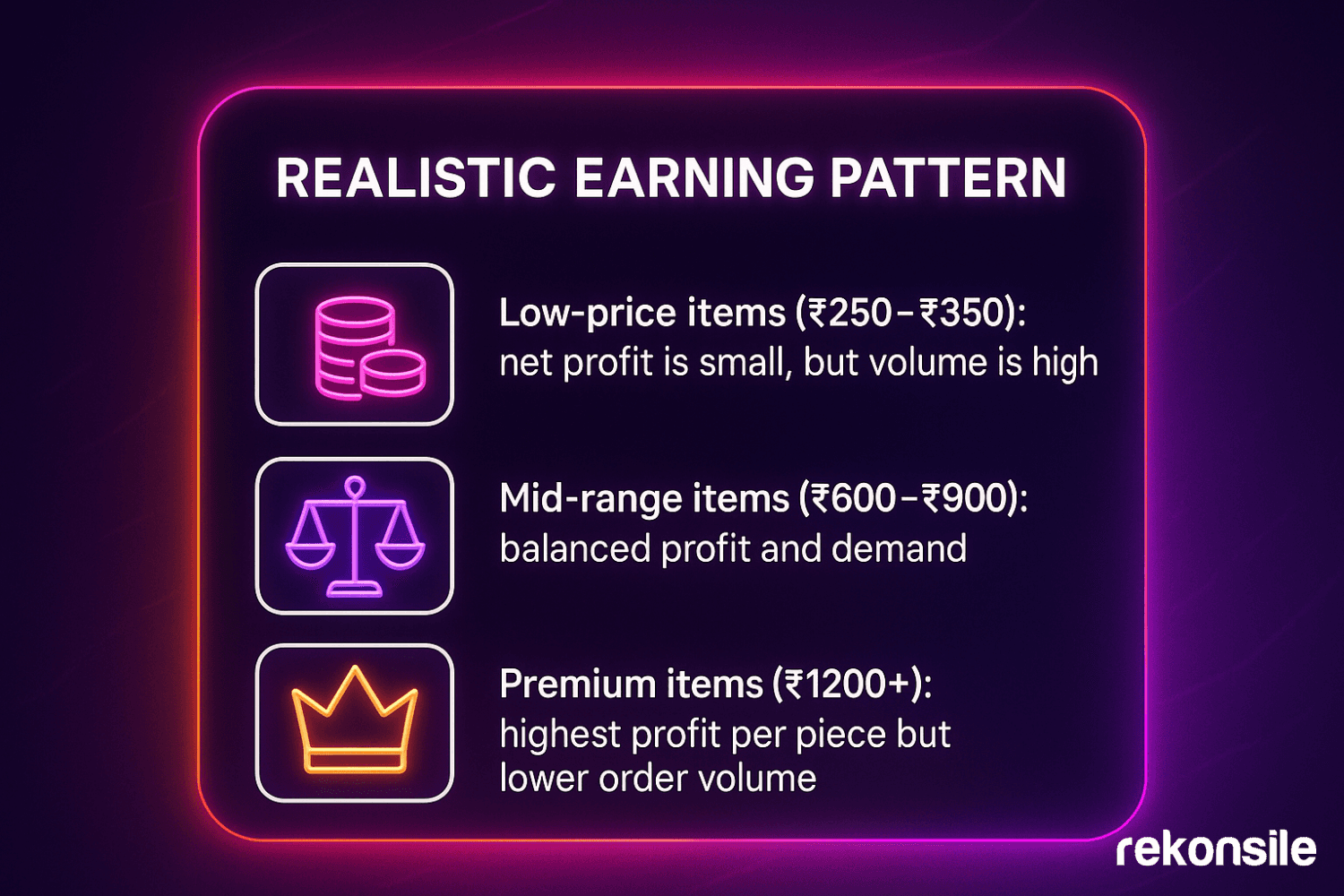
A realistic earnings pattern looks like this:
Low-price items (₹250–₹350): net profit is small, but volume is high
Mid-range items (₹600–₹900): balanced profit and demand
Premium items (₹1200+): highest profit per piece but lower order volume
The key to earning well on Myntra is minimising returns. Each return affects both the net payout and seller score. This is where regular settlement checks inside Myntra Seller Central help sellers stay alert. Tools like Rekonsile assist by flagging revenue leakages from RTO, missing reimbursements, or delayed settlements. Even catching two or three leakages per month increases profitability.
16) Pricing strategy for better profit on Myntra
When setting prices on Myntra, do not rely on flat margins. Use a reverse calculation:
Final Selling Price (FSP) → minus commission → minus logistics → minus GST → minus promotions → equals actual profit.
Myntra Seller Central offers a built-in calculator. It lets you test multiple MRP and offer-price combinations. Sellers should aim for at least 2× their manufacturing cost to stay profitable on Myntra, especially during sale seasons when discounts increase.
Rekonsile Pro Tip: is experimenting with “size-level pricing.” If a specific size, like XXL, has lower inventory and slow sales, pricing it slightly higher can maintain profitability without hurting demand. Myntra customers generally accept small size-based price variations.
17) Advanced tools inside Myntra Seller Central
As you scale, you will start using deeper tools in Myntra Seller Central, such as:
The Performance Dashboard
The Returns Analysis page
The Demand Forecast section
The Catalogue Health Score
The Category Insights tab
These tools tell you which SKUs sell fastest, which sizes get returned most, and which styles are trending. This helps you plan stock scientifically rather than guessing. Sellers who consistently study these reports become top performers on Myntra.
Once you manage hundreds of orders monthly, your settlement reports will grow huge. This is one of the points where sellers often introduce reconciliation support from Rekonsile to track return leakages, negative payouts, or missing credits. It works alongside Myntra Seller Central and ensures no revenue is lost.
18) Is selling on Myntra profitable?
Yes, Myntra can be highly profitable, but only when sellers understand fees, manage returns, maintain catalogue quality, and track deductions closely. The fashion audience on Myntra is extremely active, and trending styles sell out fast. Many small boutiques become large brands simply by mastering a niche category and maintaining consistent ratings. The sellers who struggle are usually those who don’t review their settlement data regularly or ignore catalogue rules.
Using Myntra Seller Central strategically, combined with strong reconciliation habits, keeps your business healthy and scalable.
The Bottomline
Selling on Myntra is one of the fastest ways to grow a fashion brand in India. With the correct listing process, strong catalogue standards, accurate pricing, and a clear understanding of fee deductions, any seller can achieve sustainable profits. Myntra Seller Central is powerful, but it requires careful attention to metrics, returns, and payouts.
